Popular Walking Tours in Vienna: Karlskirche Wien to Belvedere Palace

Belvedere Palace
Our website uses affiliate links. There is no extra cost when you click through and complete a purchase. However, we receive a small commission that helps fund our ongoing travel blogging effort. For further information, review our disclosures.
Table of Contents

Main Altar of Karlskirche Wien
Answering Questions About Walking Tours in Vienna | The Five Ws

Karlskirche Wien, a must see on walking tour in Vienna


Vienna Soviet War Memorial, part of one of the best walking tours in Vienna

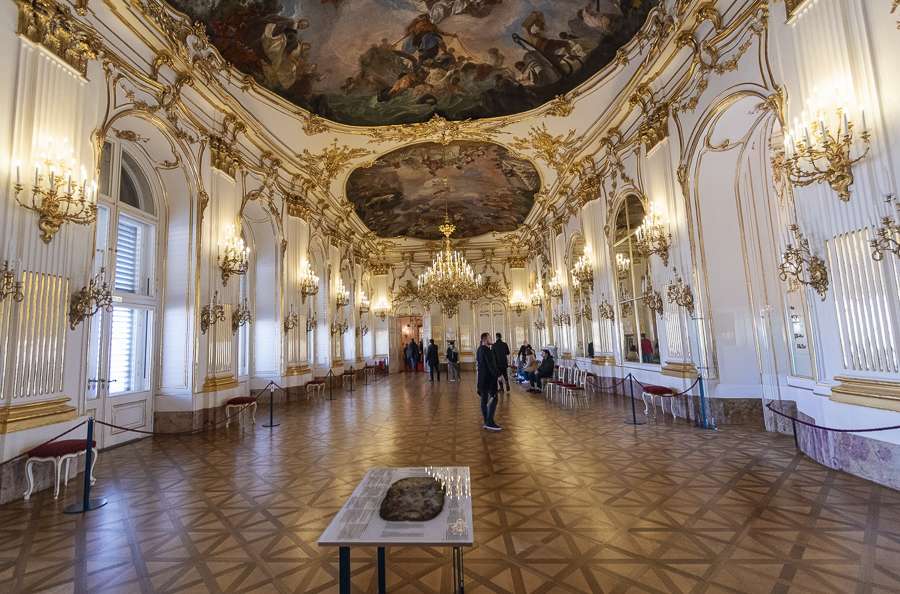
Marble Hall at Upper Belvedere Palace
Walking Tours in Vienna: Our Personal Experience and All the Details You Need to Know
Walking tours in Vienna… a city best discovered on two feet.
Vienna consists of three primary tourist zones:
Here, the focus is on the 3rd tourist zone, an area featuring multiple high-profile attractions, all in close proximity to the Innere Stadt and within easy walking distance of one another. The walking tour begins at Karlskirche Wien (St. Charles Church in Vienna). Importantly, if your hotel is in the Innere Stadt area of Central Vienna, it will be a very manageable and pleasant walk. Your second stop will be the Vienna Soviet War Memorial, before finishing your day touring the Upper Belvedere Palace’s museum and gardens.
This route is perfect for an elongated half-day or full-day in Vienna. Our full timeline, precise walking times/distances, and how much time you’ll likely allocate to each stop were outlined earlier in this post. Overall, the journey involves Austria’s fascinating history from the Habsburgs to WWII and beyond, amazing Baroque architecture and gardens, the importance of Christianity throughout the nation’s history, and artistic works from medieval times to the 20th century.
And while you can certainly secure a guide for the Upper Belvedere, the day can also be tackled entirely on a self-guided basis, allowing you to take things at your own pace, wander a bit along the way, and possibly add in further stops nearby (we include numerous suggestions at the end of this publication).
We hope you enjoy your time in Vienna. Read on for more details on today’s main attractions.

Dome Fresco at Karlskirche Wien
1st Stop – Karlskirche Wien
Highlights of Karlskirche Wien

Side View of Main Altar at Karlskirche Wien
Church Timeline and History
In Early Modern Europe, a period roughly from the 1300s to 1700s, the continent faced devastating plagues. Some affected specific countries or regions, while others, like the Black Death, had a broader impact across Europe. The Great Plague of Vienna (a bubonic plague) in 1679 killed an estimated 20-30% of its population, marking the most damaging plague event in the city’s history. Yet again in 1713-1714, the city was struck by another bubonic plague, which killed thousands more locals.
During the Habsburgs reign, Holy Roman Emperor Charles VI ruled from 1711 to 1740. Charles had no male heirs who lived to adulthood, but one of his daughters, Maria Theresa, became one of Europe’s most prominent female rulers and was also the mother of Marie Antoinette, who became the French Queen.
In response to the plague in Vienna, Charles VI committed to having a church built in the Habsburgs most important city, Vienna. The church would be named after the Emperor’s namesake patron saint, Saint Charles Borromeo, which carried additional significance at this moment. He served as a Cardinal and the Archbishop of Milan during the city’s 1576 plague, and he is credited with leading Milan out of it through a combination of prayer and hygiene measures. After his death, the Pope canonized Saint Charles Borromeo in the early 1600s.
Construction of the church began in 1716, with its Triumphal Columns built between 1724 and 1730. The process was completed in 1737, and the church was consecrated on October 28, 1737; however, the interior decorations continued into 1738.
In 1733, the church’s spiritual leadership was placed under the control of a religious order known as the Knights of the Cross with the Red Star, a group dating back to the Holy Crusades. While the Order expanded in neighboring countries during the 1700s, by the late 1800s, it had become entirely focused on Karlskirche Wien.

Angel Statue outside of Karlskirche Wien

Outside of Karlskirche Wien, Baroque column showing scenes from life of Saint Charles Borromeo
Key Focus Areas During Your Visit
The Baroque-style church is most commonly visited on a self-guided tour with a ticket purchased in advance. We recommend budgeting 90 minutes for your time at Karlskirche Wien, but it certainly might take slightly less time, even closer to one hour.
Here’s some guidance on what to focus on during your visit to the church:

Vienna Soviet War Memorial, part of walking tour in Vienna

Vienna Soviet War Memorial also called Heroes' Monument of the Red Army
2nd Stop: Vienna Soviet War Memorial
Highlights of Vienna Soviet War Memorial
From Karlskirche Wien, it’s just a short walk to the Vienna Soviet War Memorial, which honors Soviet soldiers who died in the Battle for Vienna.
During the latter stages of World War II, Soviet forces (Allied Powers) pushed steadily west through Central Europe. After battles in Hungary, including within the capital city of Budapest, Soviet army units advanced to Vienna. The two-week Battle of Vienna was fought in early April 1945 between German soldiers and the Soviet Army; remember that in 1938, Austria (and Vienna) had been annexed by Germany and was both politically and militarily part of the German state. While the Soviets were ultimately victorious, approximately 15,000-20,000 of their troops were killed during the battle.
The Soviet victory at Vienna by mid-April was crucial to ending the war with Germany. During the 2nd half of April, additional Soviet forces took on the German Nazis at the Battle of Berlin. Then, in close sequence, Adolph Hitler took his own life on April 30, the city of Berlin surrendered on May 2, and Germany’s unconditional surrender was finalized on May 8, 1945, effectively ending WWII’s European Theater.
After their success on the battlefield, the Soviets moved quickly to build a Memorial in Vienna honoring their fallen soldiers, completing it by August 1945, near identical timing with Japan’s final surrender that same month. Observers have viewed the Soviets’ rapid approach to building the Memorial, in part, as a powerful political move to solidify their influence in Central Europe at the beginning of the Cold War.
The Memorial stands as one of the anchors at a geographically prominent square in Vienna, Schwarzenbergplatz. The Hochstrahlbrunnen Fountain stands in front of the Memorial and carries historical significance, commemorating Vienna’s completion of a water supply pipeline from the Alps into the city.
The Vienna Soviet War Memorial consists of a colonnade with free-standing columns evenly spaced in a semicircular alignment. As the centerpiece, a tall marble column features a soldier carrying a flag in one arm and a shield in the other, with a machine gun resting across his stomach. The contrast of the golden shield, flagpole, and helmet contrasts sharply with the dark colors of the soldier and his uniform.

Grand Staircase at Upper Belvedere Palace
3rd Stop: Upper Belvedere Palace
Highlights of Upper Belvedere Palace
Palace History
The Upper and Lower Belvedere Palaces were originally the summer home of Prince Eugene of Savoy. Prince Eugene moved to Austria after being turned down for military command duties in his French homeland. He rose rapidly through the ranks of the Habsburg army and was well respected as a military leader defending the empire against invading Ottomans. Eventually, he ascended to become President of the Imperial War Council.
As his prestige increased on the battlefield, he also became financially successful as the beneficiary of two French abbeys. During the late 1600s-early 1700s, Prince Eugene purchased/constructed three major properties: Himmelpfortgasse (a winter residence in central Vienna), Schloss Hof (a country home and hunting lodge outside Vienna), and Belvedere Palace (a summer residence).
Construction of the vast grounds/gardens at Belvedere began in 1704 (completed 1718), the Lower Belvedere construction started in 1712 (completed 1717), and the Upper Belvedere Palace was initiated in 1717 (completed in 1723). Prince Eugene passed away in 1736, but less than 20 years later, Empress Maria Theresa acquired the entire complex and began repurposing the homes as public museums.
The grandness and historic significance of this property reached its apex on May 15, 1955, when the Upper Belvedere Palace was used as a signing venue for the Austrian State Treaty between the four former Allied Powers of WWII and Austria. The agreement officially ended Austria’s occupation, and Austria regained its independence.
Although the Belvedere 21 was not part of the original complex, it became tied to the Lower and Upper Belvedere in 2018. Originally, the building’s shell was built for the Brussels World’s Fair and adapted for its permanent museum usage in the 1950s.

Carlone Hall at Upper Belvedere Palace
Floor-By-Floor Museum Guide and Gardens
Floor 0
The Belvedere’s bottom floor starts your chronological journey through the renowned art museum. Floor 0 contains pieces from the 1200s to 1600s, encompassing the Romanesque, Gothic, and Renaissance periods. However, before getting to the period artworks, you’ll begin in Carlone Hall, a small room with elaborate frescoes covering the walls and ceilings dedicated to the Gods. In the middle of the open room, you’ll find a rotating piece of contemporary art designed to serve as a bridge between the art from the older periods you’ll soon see and the present. During our visit, we saw Arched Landscape by a Swiss artist.
Many of our Floor 0 favorites featured Christian-themed works, including a wooden crucifixion and winged altarpieces. Most European churches from this era featured altarpieces that depicted a Christian story. These creations had hinges and doors that could be left open or closed, but the story was told throughout, and it was often the practice to open the altarpiece only on special days like Christian holidays or Sundays.
The Znaim Altarpiece is a beautiful example from the 1400s. The carved Christian relief scenes create a true three-dimensional effect, ranging from an interior depicting the carrying of the cross and crucifixion to exterior panels depicting Jesus’ Baptism and the Last Supper.
The bright white stone Grand Staircase connects Floors 0 and 1. You’ll appreciate the Baroque architectural designs as you climb the marble staircase while studying the many reliefs carved into the walls and ceiling. The breaks in the non-white coloring come only from the black wrought-iron lamps and window frames.

"Character Heads" by Franz Xaver Messerschmidt at Belvedere Palace
Floor 1
You’ll likely spend most of your time on this museum floor, which begins with the most historically important and beautiful room in the building, Marble Hall. Here you’ll find ceiling frescoes portraying the virtuous pursuits of Prince Eugene’s family. The room is stunning, with large windows and various shades of brown marble. If you can pull your attention away from the room itself, there are great views of the main gardens outside from this vantage point.
It is in this room that the Austrian Independence Treaty was signed in May 1955 by representatives of the Austrian government and leaders of France, the Soviet Union, the United Kingdom, and the United States. The signing ended a decade-long post-WWII occupation following Austria’s involvement on the German side. Austria is now in a very select group of nations worldwide with a policy of total neutrality in war.
As you’re walking the remainder of the 1st Floor, you’ll be reminded that beyond the displayed artworks, the palace itself has its own historical story. In each direction, there are some 6-8 rooms on each side of the centrally located Marble Hall, including the Coffee Room, Games Room, Picture Gallery, Antechamber, Conference Room, Bedrooms, etc. Many are ornamental in their own right, filled with ceiling reliefs, elaborate tapestries, and some furnishings. The most singularly stunning room (other than Marble Hall) may well be the Chapel, which shows a ceiling fresco and sculptures of biblical figures from the Bible’s New Testament.
At opposite ends of the floor, visitors will discover two of the museum’s most important and intriguing artworks: Gustav Klimt’s The Kiss and Franz Xaver Messerschmidt Character Heads. Klimt is the most famous painter in Austrian history, and this is his signature work. He’s known for his paintings of women, and this painting, created in 1907, shows a couple literally melting into one person. In the 1760s-1770s, Messerschmidt used various media to create approximately 60 unique busts of Character Heads, illustrating a full range of emotions and facial expressions. It is estimated that only 50 of these heads are on public display worldwide, and the largest collection is at the Belvedere.

Gallery Room at Belvedere Palace

Statue in Gardens of Belvedere Palace
Floor 2
Public displays on the 2nd floor are more limited than on the other two museum floors, with a focus on 20th-century artworks; the space can also be used for temporary exhibits.
Gardens
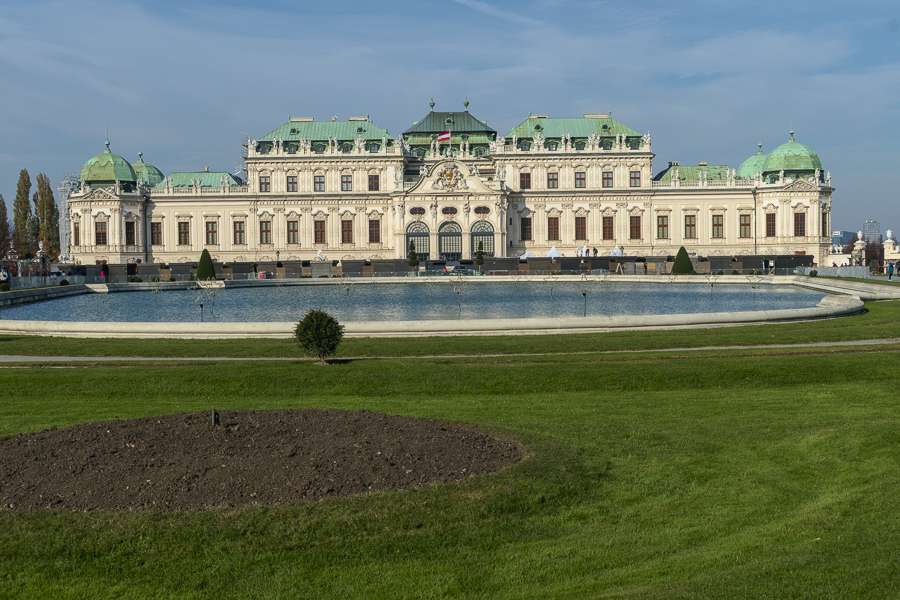
Extending over three large terraced levels, the main Palace Gardens are located between the Lower and Upper Belvedere. In the late-Baroque French style, the gardens are designed to be symmetrical, containing flowers, hedges, multiple fountains, and artificial water basins. Don’t forget to walk to the south side of the Upper Belvedere to see Große Basin, which creates a mirror effect when looking at the Palace from afar.
There are two other notable gardens within the Belvedere complex: the Privy Garden (west of the Lower Belvedere) and the Sculpture Garden (adjacent to the Belvedere 21). While the Sculpture Garden is free for visitors, touring the Privy Garden requires the purchase of a separate ticket, available at the Lower Belvedere.

Lower Belvedere Palace
Nearby Attractions: Walking Tours in Vienna
As a city, Vienna offers an incredible collection of museums for tourists, which can make choosing which ones to visit somewhat overwhelming. Nevertheless, this particular walking tour in Vienna allows you to add further activities nearby or back in the heart of Vienna’s Innere Stadt.
Below, we provide the best options for additional attractions if you want to remain close to today’s walking tour.
- Lower Belvedere Palace – Complementary to the Upper Belvedere, but geared towards a focus on Prince Eugene’s residential space, medieval and Renaissance art, and temporary art exhibits. Visitors will also gain access to the next-door Privy Garden.
- Belvedere 21 – Similarly, part of the extended Belvedere complex, although both its building and focus are far more modern than the Upper and Lower Belvedere. The museum focuses on contemporary art, film, and music, as well as an outdoor sculpture garden.
- Musikverein – Austria’s most prominent classical music venue. If you are unable to attend a live evening performance during your stay in Vienna, daily tours are offered in both English and German. Note that tours are not available on Sundays.
- Albertina Modern – While you may be most familiar with the flagship Albertina Museum in the heart of the Innere Stadt, there are actually two additional museums under the Albertina umbrella. Albertina Modern is located next to the Musikverein and houses a substantial collection of modern and contemporary art. We’d encourage contemporary art fans to consider visiting both the Albertina Modern and Belvedere 21.
- Hundertwasserhaus – This apartment house is simultaneously a Vienna architectural landmark for its unusual curved designs and range of colors. Visitors are unable to tour the apartment’s interior, but can fully relish the unique exterior design from the sidewalk.
- Museum of Military History – The museum focuses on Austrian military history from the 1500s to modern day through four large collections: uniforms and equipment, weapons and technology, artworks, and audiovisual media displays.
- Cemetery of St. Marx – Famous composer Wolfgang Amadeus Mozart is buried here in a previously unmarked gravesite; today, a monument strategically marks the suspected location.
- Naschmarkt – The popular outdoor market for locals and tourists has a centuries-old history and features more than 100 local food stalls and restaurants.

Musikverein
Related Posts
Welcome.
We’re Brent and Missy.

Planning a vacation requires hours of research.
Which destinations are worth visiting? What should you see? What can you skip? Where should you stay? How do you fit it all into one trip?
WE GET IT.
That’s why we study the details, share what we’ve learned, and help you discover the experiences that make a destination special.
Less searching… Better planning… More time enjoying the trip.


Popular Posts



Social Media

Recent Posts