
Austria’s Best: Exclusive Guide to Vienna Music Tourism

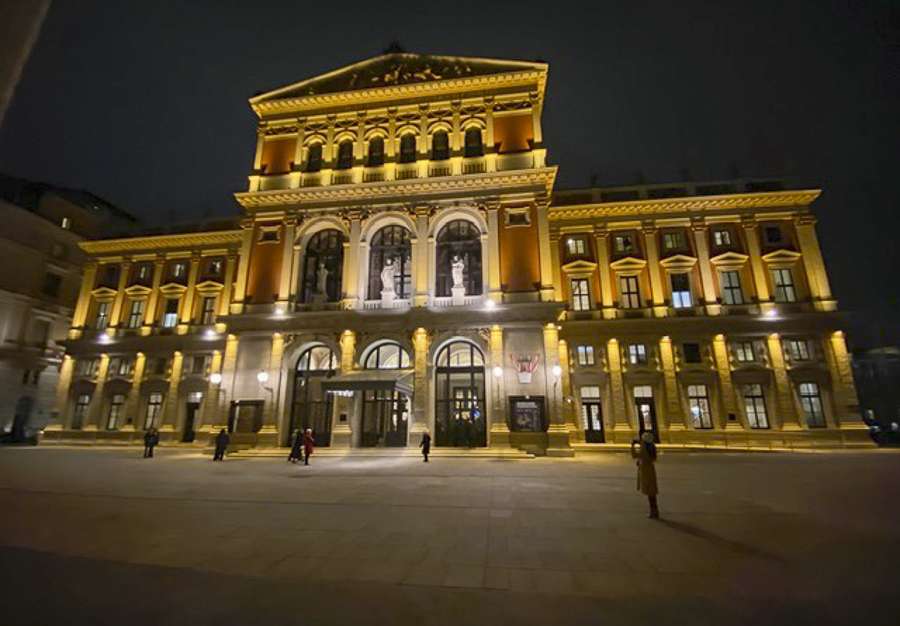
Exterior of Musikverein
Our website uses affiliate links. There is no extra cost when you click through and complete a purchase. However, we receive a small commission that helps fund our ongoing travel blogging effort. For further information, review our disclosures.
Table of Contents

House of Music exhibit
Answering Your Questions About Vienna Music Tourism | The Five Ws

Musikverein Concert Hall


Interactive Virtual Conductor exhibit at House of Music

Balcony and Ceiling of Golden Hall at Musikverein
Vienna Music Tourism: Our Personal Experience and All the Details You Need to Know
On your first trip to New York City, you visit Broadway. In Washington DC, it’s the National Mall. Los Angeles a studio tour, and Orlando has theme parks. For Vienna, most would say… the Habsburg Imperial palaces: Hofburg, Schönbrunn, and Belvedere.
It’s impossible to argue with tourists visiting these magnificent castles: the architecture, the history, the artistic works, the gardens… But today, when we look back upon the Habsburg lasting legacy, its most powerful action may well be the Empire’s influence on the development of classical music.
No trip to Austria’s capital is complete without a true Vienna Music Tourism experience! Here you will have an abundance of options, but don’t limit your musical adventures to just one. A perfect place to begin is at one of the Vienna music museums, including many former residences of Vienna’s famous composers. Next up: classical music at a historic, beautiful Vienna concert hall. And finally, a rapid introduction to ballroom dancing with a Viennese Waltz lesson.
Remember, Vienna is classical music. And classical music represents the very heart and soul of Vienna.
Vienna House of Music | Musikverein | Tanzschule Rueff Dance School


Piano Staircase at House of Music
Vienna House of Music – Practical Science and Vienna Music History
Five Notes on the Vienna House of Music
All About Vienna House of Music
The perfect introduction to Vienna’s world-renowned composers and the beginnings of the Vienna Philharmonic, along with a broad range of interactive stations that teach visitors about noise/sounds and musical instruments.
The Vienna House of Music museum occupies the building where Otto Nicolai established the Vienna Philharmonic Symphony Orchestra back in the 1840s. First opened in 2000, this building, rich in history and in the heart of Vienna, now houses four floors of music education for Austrians and international tourists alike—an educational and fun stop for both children and adults.
- 1st Floor – The First Floor exhibition focuses on the Vienna Philharmonic. Visitors can learn about the orchestra’s formation and initial makeup, and see displays showing the first concert poster from March 1842. There is a film room playing a loop of the orchestra’s famous New Year’s concert, one of the most-watched annual concert events. Further displays show the silhouettes of past conductors during performances and even the batons utilized by some of these same orchestra leaders.
- 2nd Floor – The Second Floor shifts attention from history to science through an exploration of sounds called Sonotopia. The floor’s teachings are highly interactive and encourage visitors’ participation. Listen to sounds as an owl, turtle, or chimpanzee would hear them. Stop at the terminals involving the physics of sound: frequency, amplitude, and period. And learn how vibrations create sound waves in different ways. Finally, you can learn about the different instrument classifications and variations, touch and play them. You can spend a long time here!
- 3rd Floor – On the Vienna music museum’s Third Floor, visitors return to Vienna’s musical history by spotlighting the city’s most famous composers: Haydn, Mozart, Beethoven, Schubert, Strauss, and Mahler. Each composer has their own distinct room, where you can read a digital biography of their personal and professional life, along with other visual displays. The museum continues to shine with additional interactive stations, including one where you create your own musical score.
- 4th Floor – As a grand museum finale, the Vienna House of Music’s Fourth Floor turns the power back to its visitors because now you can jump into the exclusive role as virtual conductor for the Vienna Philharmonic. After gaining trips from a star conductor, the onscreen orchestra will react to the movements of your baton. Choose your musical selection, and define the speed, volume, and focus of your conduction based on your desired outcome. Needless to say, we are not quite ready to step out from the shadows of this virtual reality onto the main stage, but it’s incredibly exhilarating and exhausting at the same time.
I should also mention that the stairways connecting certain floors are interactive meaning that each step is a musical note, as if the keys on a piano with corresponding lights and sounds. At this moment, we’ll ignore the fact that I aggressively elbowed a group of grade schoolers to create my own music on the stairs (just kidding… or am I?).

Golden Hall at Musikverein
Musikverein – The Perfect Classical Music Experience
Five Notes on Musikverein
All About Musikverein
Musikverein Golden Hall is the must-see classical music Vienna concert hall, but it’s also in legitimate discussions as one of the top concert halls in the world. Your visit checks off three major reasons to celebrate music while in Vienna: 1) the music in an environment of perfect acoustics, 2) the exterior and interior grandeur of this Vienna concert hall, and 3) an evening here is a true celebration of the culture and history of classical music in Vienna.
And I Digress… Here’s a funny story; one that starts as a horrible calendar mistake on our part, but ends with an act of great kindness from the box office staff at Musikverein.
We spent four nights in Vienna, and we had carefully purchased tickets to an orchestra performance on the 3rd night. However, somewhere amidst our planning, we had recorded it in our travel records for the 4th and final night of our time in Vienna. We approached the box office that evening, our printed tickets in hand. Upon handing them to the Musikverein staff, we were informed that these tickets were for last night’s performance.
100% my mistake; I literally could have broken down on the spot. Immediately, however, the staff member reached out to a supervisor and re-worked our tickets for that night’s performance. So incredibly gracious, and the ticketing change was not something we requested. The staff did all of that on their own. The performance that night was by a different traveling orchestra than the night of our actual tickets, so there was extra accommodation from the staff.
For us, it didn’t matter where our seats were located. It didn’t matter that we saw a chamber orchestra rather than a full orchestra with a choir accompanying it. We consider ourselves incredibly lucky to have had our special night out at the Musikverein in Vienna. Thankfully, there was another concert scheduled for that evening, and the staff (wish we had their names) was kind enough to give us that opportunity without hesitation.
That night, we witnessed a chamber orchestra (approximately 30 musicians) and featured solos separately from a world-class pianist and a cellist. The music came from an Italian opera, including one piano concerto by the German-born (but Vienna claimed) composer Beethoven.
As an aside, our ticketed event would have been a combined choir and orchestra performing liturgical/church music from composers including the Austrians Schubert and Haydn. To reiterate… for novices, it does not matter who you see perform; what matters is that you book tickets (and arrive on the correct night!).
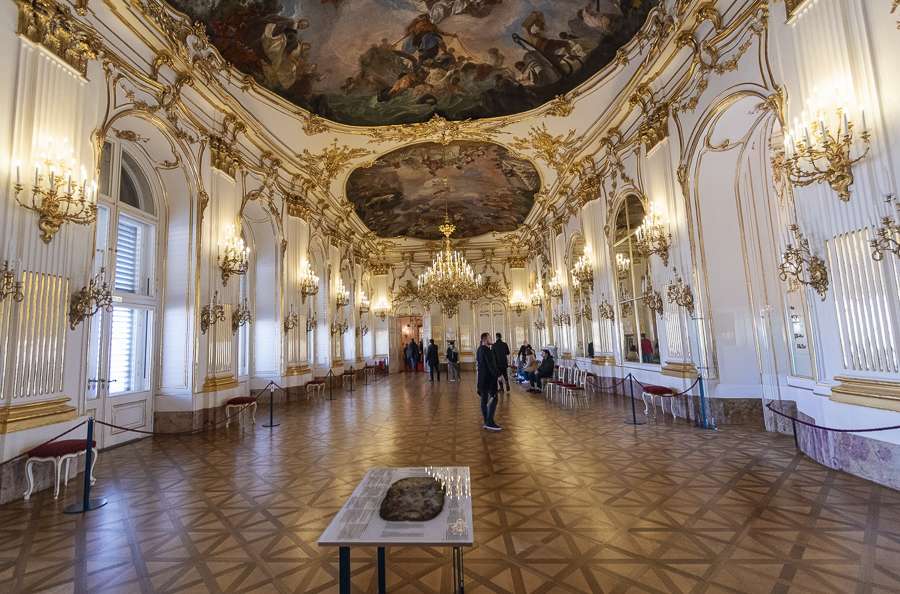
Musikverein’s Great, or Golden, Hall is shaped in the traditional shoebox-style: long, rectangular, and tall. This traditional shape is considered perfect for sound and acoustics. The beautiful Vienna concert hall is adorned with Greek influences throughout, decorated with gold leaf and marble. The side of the ground level is adorned with statues/carvings of female figures serving simultaneously as pillars/columns.
The ceiling is covered in gold trim, frescoes, and chandeliers. In addition to the main floor seating, there are side boxes on the main level and above, as well as a large balcony. A large organ dominates the area behind the orchestra stage and has been rebuilt and renovated multiple times.

Learning the Viennese Waltz at Tanzschule Rueff

Source: Tanzschule Rueff
Tanzschule Rueff Dance School – When in Vienna… Learn to Viennese Waltz
Five Notes on Tanzschule Rueff Dance School
All About Tanzschule Rueff Dance School
Tanzschule Rueff Dance School is one of several leading dance schools operating in Vienna. Tanzschule Rueff focuses on both group courses and private lessons for beginners to dancers with very advanced skill sets. And they cover all ages, from teenagers to adults.
For tourists, they offer the popular “Hop on Waltz” class, a blitz approach to learning the Viennese Waltz, held every day. The one-hour classes are an excellent way to take in Viennese culture during a brief stay in the city. In fairness, it is truly difficult to learn this dance in a single session. While the steps are relatively straightforward and consistent, it takes time to build comfort with the dance’s speed and its fast-turning pattern. The Viennese Waltz is considered one of the fastest ballroom dances.
During our Hop on Waltz session, we were the only two dancers in attendance. In some respects, that is very good, as we received 100% of our instructor’s attention. However, it also meant that we were dancing continuously, which became somewhat tiresome (and dizzying).
Our educational process begins with basic box waltz steps, including posture, arm positions, and initial steps. We graduated to learning the six basic steps and completing a full rotation. We completed the steps by counting individually and separately at first, before attempting (and I mean “attempting”) to dance seamlessly as a couple. Towards the end of our class, the instructor introduced a musical accompaniment to our routine. Even with a relatively slow song, the beats and pacing were extremely difficult to keep up with, and when Missy was in rhythm, it felt like I was not (or vice versa).
Put simply, you shouldn’t expect to master these steps in one lesson, but you may only be in Vienna once, and where else would be better to give the Viennese Waltz a try? We promise that you will have a great time, laugh about it in the moment (and even more when you return from vacation), and the instructor will be extremely patient with you. Viennese Walting lessons are another essential music experience that should be part of your next Vienna vacation.

Nicolai Room at House of Music
Related Posts
Welcome.
We’re Brent and Missy.

Planning a vacation requires hours of research.
Which destinations are worth visiting? What should you see? What can you skip? Where should you stay? How do you fit it all into one trip?
WE GET IT.
That’s why we study the details, share what we’ve learned, and help you discover the experiences that make a destination special.
Less searching… Better planning… More time enjoying the trip.


Popular Posts



Social Media

Recent Posts