Vienna’s Hofburg Palace: Simplified Guide to Top Attractions

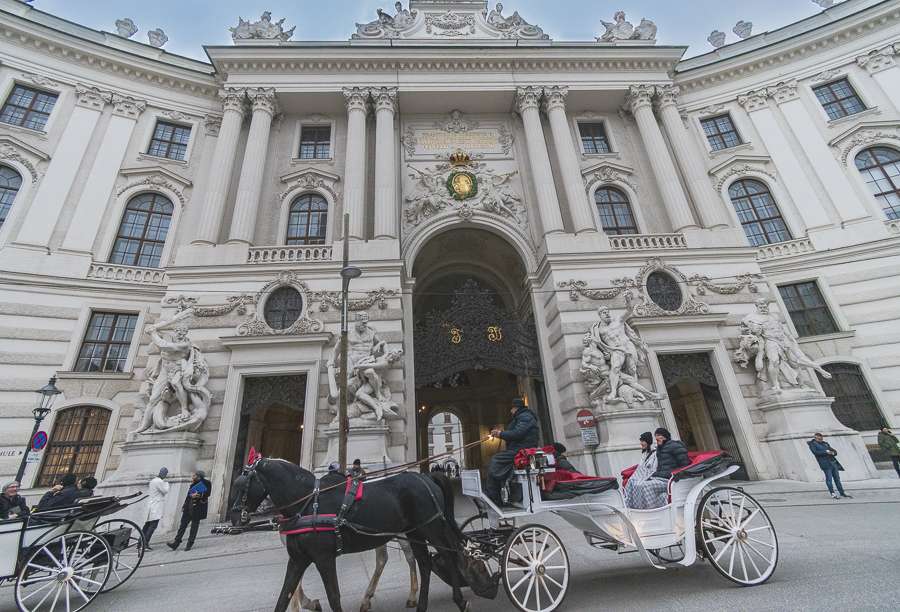
Carriage on the Michaelerplatz at Hofburg Palace
Our website uses affiliate links. There is no extra cost when you click through and complete a purchase. However, we receive a small commission that helps fund our ongoing travel blogging effort. For further information, review our disclosures.
Table of Contents

Imperial Coronation Mantle and Sword at Imperial Treasury Vienna
Answering Your Questions About the Spanish Riding School and Imperial Treasury | The Five Ws

Spanish Riding School


Imperial Crown for the Holy Roman Empire

Austrian Imperial Crown with Orb and Scepter

Heldenplatz or Heroes' Square at Hofburg Palace
Hidden Gems at Hofburg Palace Complex: Our Personal Experience and All the Details You Need to Know
For complete transparency, referring to the Imperial Treasury Vienna and the Spanish Riding School as “hidden” may be somewhat reaching. However, Hofburg Palace, as a whole, often gets the walk-by treatment from Vienna tourists, particularly relative to the Schönbrunn and Belvedere palaces. Further, other Innere Stadt attractions, such as St. Stephen’s Cathedral, the Albertina, and two nearby museums, attract dramatically larger visitor counts. And even within the Hofburg Palace complex, the Sisi Museum and Imperial Apartments are more heavily promoted and capture significantly larger annual tourist numbers.
However, we believe that, as tourist attractions in Vienna, the Imperial Treasury and the Spanish Riding School have no substitutes. While visitors to Vienna will discover plenty of options for fine arts museums, churches, or palaces, these two unique activities cannot be replicated!
Both attractions can be seamlessly incorporated into your existing Vienna itinerary on a weekend between breakfast and lunch. Remember that full performances at the Spanish Riding School are typically held Saturdays and Sundays at 11:00 am. The Imperial Treasury Vienna opens both weekend days at 9:00 am, so allocating the necessary 1-2 hours to complete your self-guided walking tour represents the perfect complement.
Read on for the highlights and a deeper dive into each attraction.

Spanish Riding School facing Lower Short Side
Spanish Riding School – A Must-See Vienna Spectacle
Four Insights from the Spanish Riding School
Spanish Riding School: A Pocket Guide
Building History
The Spanish Riding School dates back to 1565 with the original site in proximity to the current location. Construction of the winter riding school within Hofburg Palace began during the reign of Holy Roman Emperor and Habsburg leader Charles VI. The buildout began in 1729 and was completed by 1735. The facility has seen continuous renovations throughout its nearly three centuries of existence, focusing on preserving the original Baroque design qualities.
While most visitors will only see the arena itself, the large adjacent Stallburg stables are the full-time home to the 71 Lipizzaner stallions. For those taking part in the guided tour, you will be able to see their horse stalls, feeding, training, exercising, and grooming areas.
One essential related property is the Piber Lipizzaner Federal Stud Farm, located approximately 150 miles southwest of Vienna and closer to Graz, Austria. A Benedictine Abbey was first constructed here in 1716, but the stud farm is first mentioned in the late 1700s, before becoming the sole official home in the early 1900s. Today, the Abbey has become the central location for the stud farm offices, the Lipizzaner mares reside here, and stallions live out their retirement years (after reaching the age of 25-30) on the farm. Regular guided tours are available seasonally at the farm.
Training: Riders and Horses
The horse riders undertake years and years of formal training and an apprenticeship program. The process includes three years of vocational school, followed by two to four years serving as an apprentice, and finally another six years as a trainee rider, during which the candidate will work specifically with an individual stallion. Only after approximately 10 years of dedication to the process will the individual become a rider candidate or a rider.
The Lipizzaner horses carry their signature white coat, with approximately 90% of their hair in this regal white color. The horses have a muscular, almost rectangular build, and the height to their backs is approximately five feet for full-grown adults. The horses’ lineage dates back centuries, and breeding is closely managed. Interestingly, the legacy horses had coats that were exclusively brown, black, grey, or patterned, but the bright white hair you witnessed today was determined to be more regal in appearance.
The Lipizzaner is considered the oldest cultural horse breed in Europe. It will take a stallion 6-8 years before developing the skills and discipline to participate in the group program and presentation, and only the most elite stallions can successfully execute their difficult airborne maneuvers.

Spanish Riding School facing Royal Box and Ground Floor Box
Full Performances and Alternate Visit Options
Visitors to the Spanish Riding School have three primary options: full performance, morning exercises, or a guided facilities tour (the dates/times offered have been discussed previously in this article).
- Full Performances – The full performance is the most prominent attraction at the Spanish Riding School, where visitors can see the finished product in all its glory. Expect to see the show begin with an illustration of the long reining technique between horse and rider. Here, the rider walks alongside/slightly behind the horse, a process considered an essential part of training and illustrative of the relationship between horse and rider.
The most elite Lipizzaner stallions can execute impressive jumps and airborne movements. Examples include the levade, where the horse stands on his hind legs; the capriole, which involves the horse standing on his hind legs before jumping and kicking those legs into the air; and the courbette, where the horse hops on his back legs after establishing a levade position. These in-air maneuvers are likely only seen during the full performance option.
At the conclusion of the performance, expect to see the school quadrille formation, featuring as many as eight stallions with riders. The movements are all about tight precision and collective movements, set to background music.
- Morning Exercises – For those unable to attend the full performances or seeking a less expensive option, seeing the exercise training sessions represents an excellent substitute. Visitors will get to experience the same Baroque arena used for the full performances, and the riders and horses will be actively engaged in various training activities, including stretching, gymnastics, strengthening, and muscle-building programs. Note that the iconic jumps are not typically part of these exercise programs.
- Guided Tours – Unlike the performances and exercises, guided tours are available year-round. Visitors are taken behind the scenes to see the horse stables and one of the world’s largest horse walkers. These tours can be chosen during time-frames when the performances/exercises are seasonally closed/unavailable, or they can provide an excellent educational experience for those looking to supplement the show.

Cradle of Napoleon's son or also called Throne Cradle of the King of Rome
Imperial Treasury Vienna – Riches from the Holy Roman Empire and the Habsburg Dynasty
Four Insights from the Imperial Treasury
Imperial Treasury Vienna: A Pocket Guide
History
Europe’s Habsburg Dynasty lasted nearly 640 years, from approximately 1282 to the final Habsburg ruler’s forced abdication in 1918, after Austria’s defeat in World War I. The Dynasty’s expansion across Europe was unique in that it expanded through compromise and marriage rather than battlefield victories. Regardless of their expansion approach, the Habsburg Dynasty covered nearly half of modern Europe’s national borders at various points, leaving a lasting cultural legacy in areas like art and music.
Much of the collection in today’s Imperial Treasury Vienna likely began in the 14th century. However, in the late 1500s-early 1600s, Emperor Rudolf II created an Art House within Hofburg Palace to hold the crown’s most valuable possessions. The Habsburgs’ only female ruler, Maria Theresa, would significantly reorganize and improve upon this chamber in the mid-1700s. The final renovation of the chamber, which expanded and remodeled it from 1983-1987, created the space visitors see when touring today.
Museum Layout
Today, the Imperial Treasury Vienna has approximately 21 numbered rooms, 16 of which are dedicated to the secular treasury and 5 to ecclesiastical items. However, given the close relationship between Habsburg rule and their Christian faith, the lines are certainly blurred amongst these secular items.
Within the secular treasury, items come from the Austrian Empire, the Habsburg Dynasty, the Holy Roman Empire, and even rooms tied to the Habsburgs’ heritage in Burgundy (a region now part of France, Belgium, and the Netherlands). Throughout, you’ll see royal insignias and badges; ornate clothing, gowns and coronation robes; and precious stones, jewelry and other heirlooms.
The Ecclesiastical Treasury contains religious items that were stored in the Imperial Chapel’s sacristy until the mid-1500s, and were later returned to the Chapel throughout the 1800s. Finally, after WWI, the items were formally combined with the Secular Treasury. These items are typically associated with the Catholic mass and religious ceremonies, such as chalices, prayer books, crucifixes, statues, relics, and regalia.

Ceremonial Coat of Arms at the Imperial Treasury Vienna
The Most Famous and Popular Displayed Items
- Holy Lance – The Holy Lance was part of the Holy Roman Empire’s treasured collection. The lance is believed to be from a soldier’s spear that pierced Jesus’ side and is stained with his blood. The history is written in the Gospel of John and occurred as Jesus was nailed to the cross during his crucifixion.
- Imperial Crown of the Holy Roman Empire – The crown features a large cross, an abundance of jewels, and four unique scenes of events within the Old Testament. Notably, there are twelve stones on the front of the crown to symbolize the twelve apostles. Although some date the Holy Roman Empire back to Charlemagne’s coronation in the early 800s, the crown presented likely dates to the mid- to late 900s.
- Emerald Unguentarium – The nearly 3,000 carat vessel was designed in the mid-1600s by the then Holy Roman Emperor. The jeweler’s approach focused on retaining as much of the emerald stone as possible, with the irregular shape informing the design.
- Imperial Crown of the Austrian Empire – Originally designed in the early 1600s as the personal crown of Rudolph II, it would later be recognized as the crown of the leader of the Austrian Empire. Given that the crown for the Holy Roman Emperor was kept in Nuremberg and brought out only for coronations (most Habsburg rulers held these dual titles), it became the more regular crown of the Austrian Emperor.
- Cradle of Napoleon’s Son – A cradle made for the son of French Emperor Napoleon I and Marie Louise of Austria. The cradle was made from 617 pounds of silver and features Napoleon’s star, with a symbolic eagle perched on the bed.
- Narwhal Tooth/Tusk – One of the museum’s prized heirlooms from the Habsburgs, in actuality, is the tooth/tusk from a narwhal whale. For centuries, many believed this object to be the much-cherished horn of the mythological unicorn.
Signature Attractions of the Hofburg Palace Complex
Although we’re focused on the palace’s underrated attractions, visitors should also be aware of two/three other primary attractions within the Hofburg Palace complex: the Sisi Museum and the Imperial Apartments, and the State Hall of the Austrian National Library.
Two of these attractions are available on a single ticket: the Imperial Apartments of Franz Joseph I and Elisabeth (Sisi), where visitors can view chambers, bedrooms, a living room, a dressing room, a study, and other rooms, and the Sisi Museum tells Elisabeth’s personal historical story, accompanied by a collection of her personal items and paintings, housed within the former residence of Archduke Stephan Viktor. These two combined locations are the most popular attraction at the Hofburg Palace complex.
Another ticketing option at the Hofburg involves a tour of the Austrian National Library, famous for its beautiful State Hall, a baroque design measuring nearly 80 meters in length and 20 meters in height. The State Hall was built in the 1700s and is considered one of the most beautiful library spaces anywhere in the world.

Interior of St. Stephen's Cathedral
Additional Tourist Destinations in Vienna’s Innere Stadt
Vienna’s Innere Stadt district is the city center, home to many of Vienna’s most popular tourist destinations, as well as hotels and restaurants frequented by visitors. We have a great repository of activities inside the Innere Stadt, throughout the rest of Vienna, and even just outside the city; many of these attractions are included within our 5 day Vienna itinerary. Visitors should separately note four major Innere Stadt destinations not discussed within our other dedicated publications:
- Albertina – The former residence of Habsburg Archduke Charles and his wife, Maria Christina, and their son and the property’s namesake, Archduke Albert. Today, the Albertina is a four-level museum, with two floors containing permanent exhibitions. One of these houses 20 completely restored state rooms from the Habsburg Dukes/Dutchesses, fully decorated with the opulence you’d expect: silk wall coverings, chandeliers, statues, mirrors, moldings, and many original period furnishings. The second floor with permanent exhibitions has become a world-class art museum featuring Impressionism, post-Impressionism, and Austrian art among other periods.
- St. Stephen’s Cathedral – Vienna’s most prestigious and historic church was first consecrated in 1147; the church’s second iteration finished during 1225, the South Tower in 1433, and after a 100+ year construction process, the North Tower finished by 1578. The roof’s 230,000 colored tiles represent one of St. Stephen’s signature attractions for visitors, as are the vastly different cathedral and city views from atop each of the two towers (the South Tower is roughly twice as tall as the North). The church’s catacombs house more than 10,000 deceased people, including 70+ royal members of the Habsburg Dynasty.
- Natural History Museum (Naturhistorisches Museum) – The Natural History Museum and the Fine Arts Museum face one another and were designed with a symmetrical exterior. Both were constructed simultaneously in the mid- to late 1800s at the behest of Austrian Emperor Franz Joseph I, ultimately opening to the public in 1889. The museum covers the evolution of the natural world, including a focus on Earth’s geology and an extensive collection of building/decorative stones, the dinosaurs and early human development, and a wide range of animals from insects to reptiles to mammals.
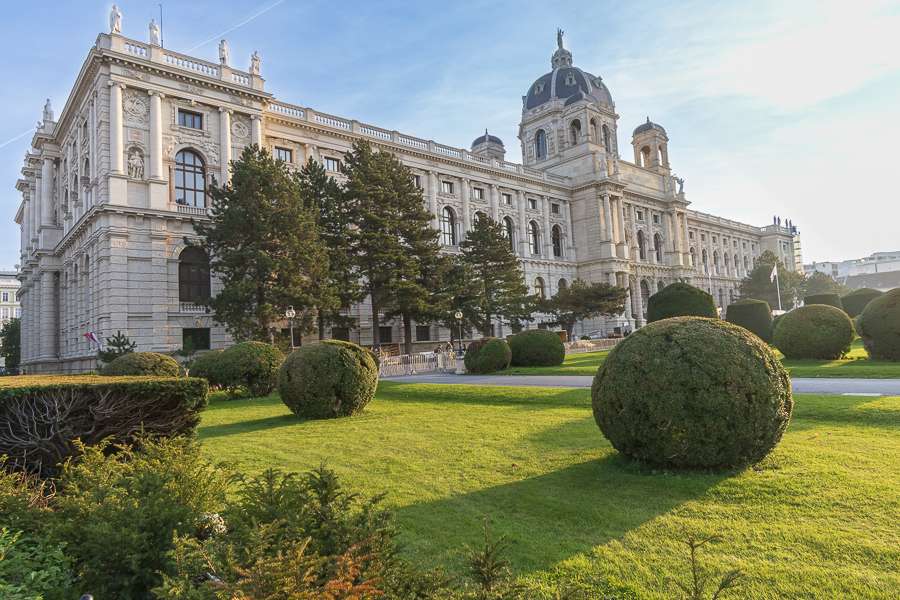
- Fine Arts Museum (Kunsthistorisches Museum) – Tickets for Vienna’s Fine Arts Museum can be purchased in combination with admission passes for the Imperial Treasury Vienna. The museum houses one of the world’s largest collections of European paintings spanning the 1400s through the Renaissance and Baroque periods. The museum surprises (typically, we’d expect to find this in a natural history museum) with an excellent collection covering ancient Egyptian art and an extensive offering of Greek and Roman antiquities. The beautiful central museum interior includes the magnificent Cupola Hall and the ornate Staircase.

Exterior of Fine Arts Museum or Kunsthistorisches Museum
Related Posts
Welcome.
We’re Brent and Missy.

Planning a vacation requires hours of research.
Which destinations are worth visiting? What should you see? What can you skip? Where should you stay? How do you fit it all into one trip?
WE GET IT.
That’s why we study the details, share what we’ve learned, and help you discover the experiences that make a destination special.
Less searching… Better planning… More time enjoying the trip.


Popular Posts



Social Media

Recent Posts