Holocaust Hero: Tour Oskar Schindler’s Factory and Kraków Ghetto

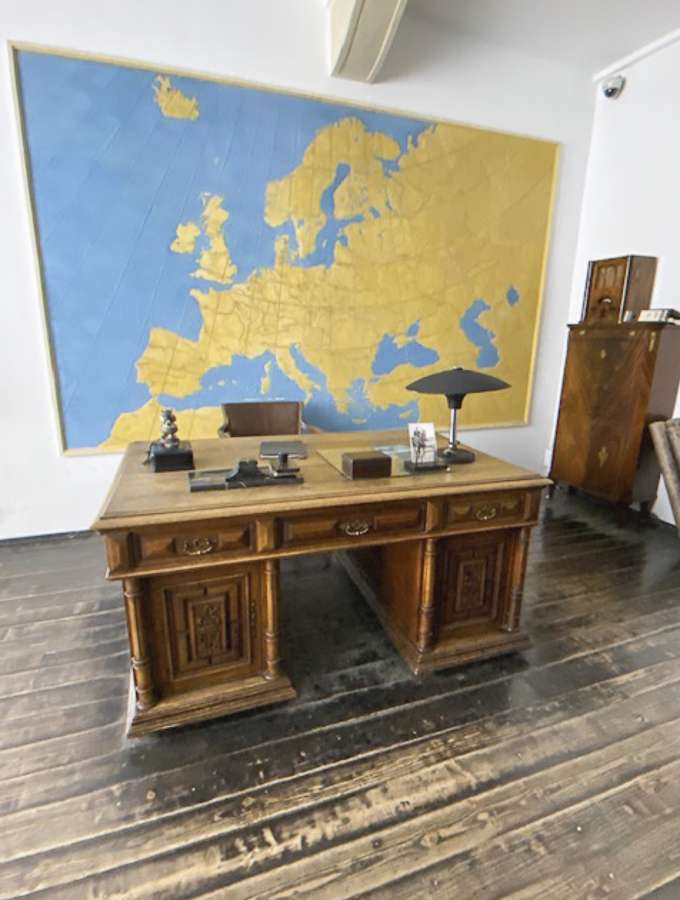
Oskar Schindler's Office
Our website uses affiliate links. There is no extra cost when you click through and complete a purchase. However, we receive a small commission that helps fund our ongoing travel blogging effort. For further information, review our disclosures.
Table of Contents

Section of Remaining Kraków Ghetto Wall
Answering Your Questions About Oskar Schindler’s Factory | The Five Ws

Gallery of Survivors


Reconnaissance TKS Tankette

Nazi Flag and Propaganda

Nazi Propaganda

Polish statue demolished by Nazis
Oskar Schindler’s Factory: Our Personal Experience and All the Details You Need to Know
Before going any further, readers should grasp the magnitude of the Holocaust:
- Pre WWII, there were 15-16 million Jewish people around the world, 9.0-9.5 million in Europe
- The Nazis systematically murdered ~6 million Jews from 1939-1945, primarily across Europe
- Pre-WWII, Poland had 3.0-3.5 million Jews, the world’s 2nd most, behind only the U.S.
- Only 11-12% of Polish Jews survived the Holocaust
- The city of Kraków, Poland, had a pre-war Jewish population of 55,000
- Amid the largest genocide in global history, Oskar Schindler heroically saved 1,100 Jewish lives
The Kraków factory, known initially as the First Malopolska Factory of Enamelware and Tin Products (Rekord), was launched in 1937… by three Jewish men. The operation went bankrupt just two short years later, in June 1939.
The Germans entered Kraków in September 1939. A 31-year-old German businessman, member of the Nazi party, and German intelligence officer named Oskar Schindler arrived in Kraków in October, becoming the new owner of the Rekord factory in November 1939. The business was renamed Deutsche Emailwarenfabrik (DEF).
Schindler would steadily transition the factory to an entirely Jewish workforce. Five years later, Schindler would relocate approximately 1,100 Jewish employees to Brȕnnlitz (now part of Czechia). These people would be liberated in mid-1945.
Today, Schindler’s Factory has been recast as two distinct museums: the industrial building now houses the Museum of Contemporary Art in Kraków (MOCAK), while the administrative office has become this historical museum focused on the 1939-1945 Nazi occupation of Kraków.
During your tour of Oskar Schindler’s Enamel Factory and the former Jewish Ghetto, you will learn about the following historical items during these times:
- Kraków before WWII
- The German invasion of Poland
- Life under German rule
- Attempts at the Germanisation of Poland
- Forced labor policies and the formation of Płaszów/Concentration Labor Camp
- Establishment of the Krakow Ghetto and later liquidation of the Ghetto
- Jewish children and elderly being mass-murdered in the streets
- Schindler’s role in saving 1,100 Jewish people
- The Soviet liberation of Poland

Railway Station
Visiting Oskar Schindler’s Factory: 1939-1945 Kraków History, The Holocaust, and Schindler
On Kraków’s Lipowa Street, you will find a long, grey, and fairly non-descript 3-story building. Welcome to the administrative office for Oskar Schindler’s Enamel Factory circa 1939-1945! If you were wondering, the old industrial factory is located directly behind the office building; the location is now home to the Museum of Contemporary Art in Kraków.
Besides a plaque recognizing its historical importance, the office turned museum looks like any other building. However, just to your right, as you approach the Museum entrance, you will see the outside facing portion of the Gallery of Survivors containing black-and-white photographs and names of the Jewish people Oskar Schindler helped to save during the Holocaust.
Now go inside… the museum’s first floor is solely administrative: ticket office, museum store, a café, coat/bag check station, and access to a temporary exhibition area. If you’re meeting up with a tour guide/tour group, typically, this will be done outside the front of the building, as the interior lobby can become rather congested. The museum route is done chronologically, beginning on the 2nd floor, then the 3rd floor, and finishing with a small area on the museum’s 1st floor.
The 2nd floor sets the table for what you’ll see throughout. Everyday life in Kraków before Germany invaded and started World War II. Know that approximately 25% of the pre-war local population was Jewish. Some rooms are set as scenes from the time, including a railway station containing video of passengers returning from summer holidays. It’s peaceful… it is normal.
The museum timeline then quickly shifts to the German Blitzkrieg. The German military attacked Poland from multiple points with a rapid, aggressive approach, unlike what military warfare had looked like in the past. WWII began on September 1, Kraków surrendered by September 6, the Soviets invaded Eastern Poland on September 17, and the entirety of Poland was taken by early October. Visitors will hear the sirens and see the military equipment. The peacefulness of the first room comes to a quick and startling end.
Your museum tour advances beyond the initial invasion to Germany’s occupation of Kraków. The Nazis targeted Jewish intellectuals and artists, older people, women, and children, sending them off to concentration camps. They focused on keeping laborers with the skills capable of hard work and jobs in factories. Those people were deemed essential (but “essential” was only a temporary term to the Nazis).
During the occupation (and in the museum), visitors will see vast amounts of Nazi propaganda and attempts at the Germanisation of Poland; the central plaza, for example, was renamed Adolph Hitler Platz. Nazi flags and signs of their rule will be everywhere. There is a fenced-in monument, symbolizing Poland’s history and battle victories against the Teutonic Knights, and the Nazis had knocked off the statue’s head.
The final rooms on the 2nd floor and initial rooms on the 3rd floor shift to the Nazi relations with Jewish people: a railway station utilized primarily for deportations of Jews, stolen Jewish belongings, the Nazi labor office, and the establishment of the Jewish Ghetto. Jews were required to wear white arm bands with the Star of David for identification. The Ghetto isolated Jews from the Kraków population and was surrounded by large stone walls (some of which remain today).
Tourists will next reach the museum’s primary memorial points to Oskar Schindler: a room with his reception desk and his office, including a desk and wall map. Within his office, you also discover an encased work of art called “Survivors’ Ark,” which involved hundreds of enameled pots similar to the ones made by the factory. Inside the exhibition are the names of the Jewish people rescued by Schindler.

"Survivors' Ark" Exhibit of Enamelware

List of lives saved by Oskar Schindler inside the "Survivors' Ark" exhibit
Towards the end of the 3rd floor comes the horrible ending: the liquidation of the Ghetto and the formation of the Płaszów Labor Camp. On March 13-14, 1943, the liquidation resulted in 2,000 Jews being shot and killed and 3,000 more transferred to Auschwitz-Birkenau, where they were murdered in gas chambers. Others were transferred to the Płaszów Labor Camp.
After revolts in the Jewish Ghetto in Warsaw and other Polish cities, the Nazis in Kraków would murder ~9,000 more Jews remaining at Płaszów between September and December 1943. Anyone left was sent to Auschwitz-Birkenau.
By 1944, Schindler had increased the number of Jewish employees in his factory from just a small number in 1939/1940 to approximately 1,100. When the Jewish Ghetto was liquidated in early 1943, the workers were transferred to the Płaszów Labor Camp. Later, Schindler created a satellite camp adjacent to his factory, where living conditions were much better than at Płaszów, and the Jews staying there would be more protected.
Visitors return to the museum’s first floor, highlighting the Soviet’s arrival, Poland’s freedom from German occupation, and the liberation of Jewish survivors. In the face of the advancing Soviets, the Nazis ordered a relocation of Schindler’s Factory. In late 1944, the workers were repostioned to Brȕnnlitz, Czechia, where a munitions plant was reestablished in a former factory. The Soviets entered Kraków in January 1945 and would later liberate Schindler’s Jewish factory workers, now in Brȕnnlitz, by May of that year.
The two final exhibits are profound and quite moving. The Hall of Choices highlights the difficult moral decisions Poles, Jews, and even Germans like Schindler were confronted with during the Nazi Occupation. Finally, the Gallery of the Survivors shows photographs of those saved by Schindler.
Walking Through Kraków’s Former Jewish Ghetto
Following the Museum tour, you can round out your historical understanding by visiting the Jewish Ghetto. There are several sections of the neighborhood where you can still see sections of the stone Ghetto wall. There are houses where Jewish people lived during the occupation and famous buildings, including Eagle Pharmacy (which is now a sister museum to Oscar Schindler’s Factory).
Historical plaques mark the locations of horrific acts by the Nazis: the 1942 murder of a group of elderly Jews, the Jewish Orphanage where 200+ children and their caregivers were killed, and the train departure point where Jews were sent away either to a labor or concentration camp. You can see the building, formerly the location of a Jewish hospital, and countless other memorials and historical markers.
Seeing the Jewish Ghetto firsthand is valuable for connecting the dots with what is learned inside the museum. Our tour of the Jewish Ghetto officially ended at the Empty Chairs Monument in Ghetto Heroes Square.


Empty Chairs Memorial at Ghetto Heroes Square
Keys to a Successful Visit
We recommend utilizing a guide service for both Oskar Schindler’s Enamel Factory and the Jewish Ghetto. Within Schindler’s Factory, there is an abundance of reading material inside, as well as items to view and audio for listening. However, group tours seem more common than individual visitors, and the groups were reasonably spaced apart. For a relatively size-constrained space, it appeared easier to navigate for groups.
Regarding the Jewish Ghetto, getting the complete history without a guide service would be difficult. Locating the most relevant historical markers is a challenge in and of itself, but understanding the broader context from limited text on plaques is relatively incomplete. Our guided tour ended at the Empty Chairs Monument, just across from Eagle Pharmacy, if you want to add a self-guided visit at the tour’s completion.
Typically, we alternate between self-guided, guided group, and private tours depending on the destination. In this case, we utilized a small group tour option from GetYourGuide, a platform we’ve consistently succeeded with during our European travels. “Kraków: Schindler’s Factory and Ghetto Guided Tour” was 3 hours. A representative met us out front of the museum (and of course, we were late… we are supposed to be better than this). The rep was friendly enough to get us quickly caught up with our guide and the rest of the group, who were already inside.
We spent approximately 2 hours inside Schindler’s Factory, followed by a short coffee and bathroom break, and then finished walking and visiting key historical sites in the Jewish Ghetto.
From November to early April, this specific tour option is offered twice daily (mid-morning and lunchtime), and a third daily option is provided late afternoon during the busier summer months when the museum’s hours are extended and there are longer daylight hours. If you are shopping instead for Museum tickets only, they can also be purchased through GetYourGuide.
Related Posts




Welcome.
We’re Brent and Missy.

Planning a vacation requires hours of research.
Which destinations are worth visiting? What should you see? What can you skip? Where should you stay? How do you fit it all into one trip?
WE GET IT.
That’s why we study the details, share what we’ve learned, and help you discover the experiences that make a destination special.
Less searching… Better planning… More time enjoying the trip.


Popular Posts


Social Media

Recent Posts