Ready for an Amazing Mesa Verde Visit?
Our website uses affiliate links. There is no extra cost when you click through and complete a purchase. However, we receive a small commission that helps fund our ongoing travel blogging effort. For further information, review our disclosures.
Table of Contents

Answering Your Questions About a Mesa Verde National Park Visit | The Five Ws


Mesa Verde National Park: Our Personal Experience and All the Details You Need to Know
Highlights of a Mesa Verde Visit
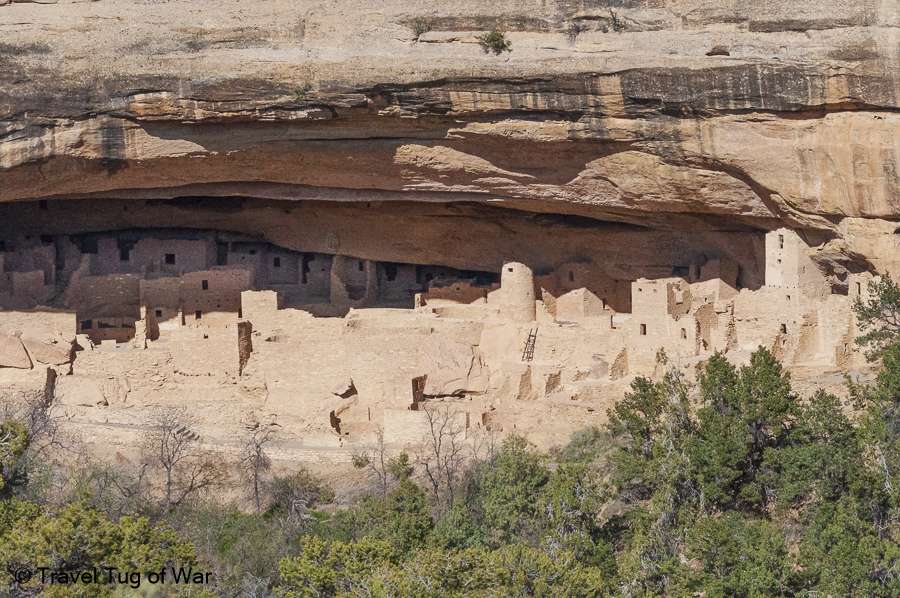
Mesa Verde National Park is a history lesson for all Americans. Our opportunity to glimpse into the Ancestral Pueblo culture from the mid-500s to late 1,200s AD. Home to the largest cliff dwellings in North America, the biggest containing 150 rooms where communities of 100 to 200 people are believed to have lived, and other four-story structures remaining intact, standing 27 feet tall.
These Mesa Verde canyons include approximately 600 distinct cliff dwellings that, at their peak, were the home to more than 5,000 Ancestral Pueblo people (and possibly significantly more by other estimates). Mesa Verde remains the only U.S. national park established in recognition of its cultural and historical significance.
Other Archeological Sites from Ancient Civilizations
Multiple National Park System monuments and historical parks within the Four Corners states focus on the Ancestral Pueblo culture, communities, civilizations, and close descendants. Many of these locations contain impressive cliff dwellings and traditional villages similar (but different) from what you can see at Mesa Verde.
Here is a quick list of those Ancestral Pueblo and Native American sites in the Four Corners region that are part of the National Park System: Hovenweep, Yucca House, Canyon de Chelly, Montezuma, Navajo, Tonto, Wupatki, Aztec Ruins, Bandelier, and Gila Cliff Dwellings National Monuments; and Chaco Culture National Historical Park. Definitely, read our detailed article on Bandelier National Monument in New Mexico, which makes for a complementary trip to Mesa Verde.
Those of us living in the United States need to have the proper perspective and education related to these locations. These communities have similar regional significance to the more well-known ancient civilizations at Petra, the Pyramids of Giza, Chichen Itza, and Machu Picchu. Get excited… Travel Tug of War articles on Petra and the Pyramids are coming soon!


A Mesa Verde Visit to Mesa Top Communities
For much of their 700 years at Mesa Verde, the Ancestral Pueblo culture’s people established communities on top of the mesa, and there is evidence that some people remained on top, even while others moved to the cliff dwellings below.
During those 700 years, their homes evolved significantly as they adapted to the environment. Communities shifted, and much of this evolution can be seen at various stops within the national park. When they first arrived at Mesa Verde, the first permanent homes were known as pithouses, where several feet of earth were dug out (like basements today), which helped moderate temperatures seasonally.
Eventually, the Ancestral Pueblo shifted to above-ground homes with multiple rooms and stories. Initially, these were constructed with mud and brush, but this evolved into using more substantial stone blocks with mud/clay-based mortar.
The original pithouses also evolved, and they began to function entirely as kivas. The sacred kiva was utilized for religious ceremonies, dances, and celebrations and as a gathering place for the families and community.
When you see the kivas today, you should imagine them covered with a roof and a ladder serving as the entrance (this is how they would have looked centuries ago). If you see a tiny hole on the floor, this would represent the passage of their ancestors into modern life (the larger hole you will likely see is a fire pit). Historians believe that in the mid-1100s, more than 35 distinct villages were surrounded by farms in these mesa top communities.

The Mesa Verde Cliff Dwellings
Mesa Verde National Park sits on a large, generally flat hill/plateau with relatively steep walls. The sizeable primary mesa actually comprises many smaller mesas that separate the various canyons. Large alcoves can form within these walls, which created an opportunity for the construction of the cliff dwellings visitors can now witness.
The park’s 52,000 acres contain approximately 5,000 archeological sites, including 600 cliff dwellings. It is believed that the cliff dwellings sprang up in the late 1100s AD, and most historians are unsure what drove the Ancestral Pueblo into these new environments. These locations utilized similar sandstone construction to the mesa top homes, with sizes ranging from single-room homes to 150-room villages. The kivas remained a focus of the cliff-dwelling communities and were typically built in front of the homes.
By the late 1200s AD, the Ancestral Pueblo steadily migrated away from Mesa Verde. Much like their move from the mesa top communities to cliff dwellings, exactly why they left the area behind remains unknown.
Three Key Focus Areas During a Mesa Verde National Park Visit
- Short Hikes – Several short hikes are spread amongst the different areas of the park: main road, Wetherill Mesa, and Chapin Mesa. Most of the focus is on hiking to cliff dwelling views or former mesa top communities, but this also takes visitors out into the park’s forested areas.
- Scenic Drives and Overlooks – At some national parks, the scenic driving part is an option for visitors. However, at Mesa Verde, the scenic drive is necessary to reach your final destinations (i.e.-the cliff dwellings). Regardless of your route selection, you will drive 25+ miles inside the national park to reach the cliff dwellings. During this drive, there are a variety of scenic overlooks of the surrounding areas, spots to see former mesa top communities, and viewpoints of the cliff dwellings.
- Ranger Guided Tours of Cliff Dwellings – For most visitors, seeing the Ancestral Pueblo cliff dwellings is the highlight of a Mesa Verde National Park trip. There are plenty of viewing locations to look down or across the canyon at these dwellings, but the park also offers special 45 to 90 minutes ranger-guided tours to see the cliff dwellings up close.

Short Hikes to Explore Mesa Verde
Unlike many of our national parks, hikes are not necessarily the featured attraction at Mesa Verde. However, they can play a valuable supporting role or bring you to the leading actor (if we’re speaking in Academy Awards verbiage).
Two classic hikes are Petroglyph Point Trail and Point Lookout Trail. Both are in the 2 – 2 ½ mile distance range and offer enough elevation change and switchbacks/bouldering to make you somewhat challenged.
And they do each have that payoff every hiker is looking for: Petroglyph, somewhat surprisingly, takes you to an extensive petroglyph collection, while Point Lookout finishes at one of the park’s highest elevations for an excellent and traditional national park scenic view of the surrounding valley and over to the Rockies.
Three other hikes at the national park stay closer to the Mesa Verde script! Long House Loop and Soda Canyon Overlook provide cliff-dwelling overlooks, while the Far View Sites hike will take you through different parts of a mesa-top community.
The Long House Loop starts/finishes at the end of Wetherill Mesa Road. A five-mile easy, paved walk runs along the top of the mesa, providing overlooks for a few cliff dwellings, including Long House, the 2nd largest cliff dwelling in the park.
Soda Canyon Overlook Trail is a much shorter 1.2 mile out-and-back trail where you’ll travel through the forest ending at an overlook for the Balcony House cliff dwelling.
Walking the ¾ miles at the Far View Sites provides perspective on the lives of the Ancestral Pueblo people during their first 500-600 years living at Mesa Verde.

Scenic Drives and Overlooks at Mesa Verde
Driving at Mesa Verde serves a similar purpose to the hikes discussed above: scenic views of the natural landscape from the upper vantage points on the mesa, as well as spots to stop off and walk a short distance to gaze upon the cliff dwellings, often from across a small valley. The National Park Service offers an excellent map, as a supplement to our map of key Mesa Verde sites shown earlier in this publication.
It’s essential to consider Mesa Verde National Park in three distinct sections.
- Main Road – After entering the park, you will travel the main road for approximately 15 miles. This section has four overlooks, numerous hiking trailheads, and a tunnel. There are no cliff-dwelling views or side trips to mesa top civilizations along this stretch, although there are some excellent views of the surrounding landscapes.
- Wetherill Mesa – After 15 miles on the main road, you can turn right for Wetherill Mesa or continue straight. Wetherill Mesa is a relatively raw 12-mile stretch involving a narrower, steeper, and curvier road with multiple pull-offs for scenic nature views on this route.
The end of Wetherill Mesa Road is the real payoff, but you must park your car and walk/hike the Long House Loop (referenced above). The hike will take you by overlooks for three unique cliff dwellings: Long House(the park’s 2nd largest cliff dwelling) and two multi-level dwellings, Nordenskiold Site and Kodak House (each was developed on two separate ledges within the same alcove).
Note that Wetherill Mesa is only open seasonally from May to September. Before visiting Wetherill Mesa, please check the national park website, as construction has closed this section of the park during 2023-2024.
- Chapin Mesa – This third driving area represents the park’s most popular section, Chapin Mesa. On the initial 5-mile drive, you will pass by two turn-offs where you can reach mesa top archeological sites: Cedar Tree Tower and the Far View sites.
After that 5-mile drive, there are three distinct “loops,” each offering pull-off opportunities for overlooks of various cliff dwellings: the Spruce Tree House area (very short loop), Mesa Top Loop (6 miles long), and Cliff Palace Loop (also 6 miles long).
We encourage you to make all three loops, as the vantage points and cliffside dwellings are all individually unique, and the viewpoints are typically directly from the parking lot. You won’t have to walk meaningful distances to get to the overlooks.

Ranger Guided Ancestral Pueblo Cliff Dwelling Tours at the National Park
Currently, there are three available ranger-guided cliff dwelling tours: Cliff Palace, Balcony House, and Square Tower House. Each of these tours is only offered from early-May through late October. Reservations are available for purchase on the recreation.gov website. Tickets become available at 8 am Mountain time 14 days in advance of your visit.
There is limited availability for these tours, and we would encourage you to be flexible with your preferred times and even with regards to the specific cliff dwelling tour you ultimately reserve. With that said, these tours are unique, cater to people of varying activity/mobility levels, and offer different tour lengths and a range of price points.
- Square Tower House Tour – Square Tower House is the most challenging tour to obtain a reservation. It is currently only offered at a singular tour time each day (early morning), and the number of visitors is capped at just ten people. The tour is also the most expensive at $25/person and the most difficult for hikers. This is a 90-minute tour that involves the tallest standing structure in Mesa Verde National Park. There is a one-mile walking distance, including two ladders (the longest being 20 feet), and some scrambling over boulders.
- Balcony House Tour – Balcony House is also considered to be a more physically demanding tour. The cliffside dwelling involves a mid-sized village, including 38 rooms and two kivas. The tour lasts 60 minutes for $8/person. Each tour has a maximum capacity of 35 people in each group. Tours are offered daily at half-hour increments from early morning to mid-late afternoon (although tours are spaced further apart during lunch-time). The tour involves climbing three long ladders (32 feet, 17 feet, 17 feet) and traveling through a 1 ½ feet-wide tunnel that is 12 feet long.
- Cliff Palace Tour – Cliff Palace is the largest cliff dwelling at Mesa Verde, with 150 rooms and 23 kivas; historians believe its large relative size signified the importance of the village and that it was likely a primary social and administrative gathering site. These ranger-led tours last approximately 45 minutes and depart every half-hour beginning early morning through mid-afternoon. The ticket price for this activity is $8/person

Added Information to Help Plan Your Mesa Verde Visit
When planning our visit to Mesa Verde, it was challenging organizing a visit to the national park that maximized our available time. In our Colorado itinerary, part of “Day 4” is devoted to laying out the ideal way to get the most out of a trip to Mesa Verde National Park, including area hotels and dining options and an hour-by-hour plan inside the park.
Given the national park’s close proximity to New Mexico, we would also suggest looking at our New Mexico itinerary, which is filled with ideas on Native American sites to visit in this Four Corners region. You also should read our Colorado and New Mexico travel guides for even more ideas and help rounding out your trip plans.
Related Posts


Welcome.
We’re Brent and Missy.

Planning a vacation requires hours of research.
Which destinations are worth visiting? What should you see? What can you skip? Where should you stay? How do you fit it all into one trip?
WE GET IT.
That’s why we study the details, share what we’ve learned, and help you discover the experiences that make a destination special.
Less searching… Better planning… More time enjoying the trip.


Popular Posts



Social Media

Recent Posts